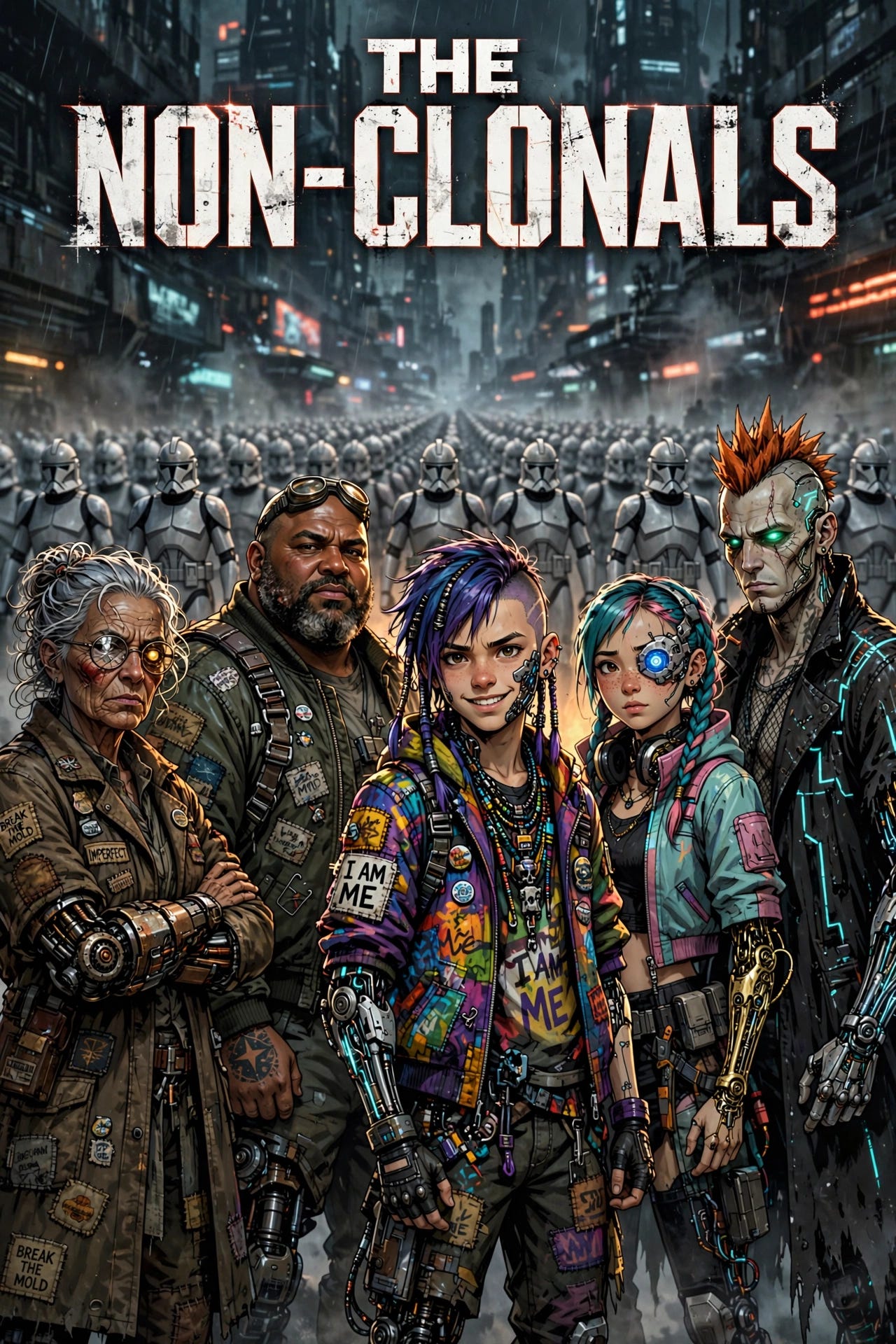
The Non‑Clonals
Episode 93 of The

Scene: Neon District, Sector 7
The clone army stood in perfect formation — rows upon rows of identical armored figures, each one a carbon‑copy of the next. Same height. Same posture. Same expressionless visor. Same everything.
Behind them, the city glowed in cold neon blues and purples, humming with the sterile efficiency of a place designed by algorithms rather than architects.
And in front of them? Five people who absolutely did not match.
They stood like a glitch in the system — colourful, asymmetrical, inconveniently alive.
The Non‑Clonals.
The Five
1. Kira - Hair dyed in three colours that clashed on purpose. Cybernetic arm covered in stickers. Spoke only in haiku.
“Neon sky flickers.
Clones breathe in perfect rhythm.
I choose chaos now.”
The clones hated this. They had no protocol for poetry.
2. Jax - Mechanical augmentations everywhere — but none of them matched. He’d installed them himself. Badly. He could hack any machine by humming at it. Nobody knew why this worked. Least of all Jax.
3. Lune - Wore a coat made of recycled holograms. Allergic to conformity. Literally. If she stood near clones too long, she sneezed.
4. Venn - Carried a neon umbrella even when it wasn’t raining. Claimed it was “for dramatic effect.” The clones had no category for dramatic effect.
5. Obo - An angry man with a personality glitch. He had developed opinions. Strong ones. He bleeped aggressively at the clone commander.
The Clone Directive
The clone army had been dispatched to “retrieve anomalies.” They expected dangerous criminals. Or rogue AI. Or malfunctioning cyborgs.
They did not expect five people who simply refused to match any template.
The clone commander stepped forward, voice perfectly monotone. “Non‑Clonals. You are in violation of Standard Identity Protocol 4.3. You must submit for pattern correction.”
Kira bowed politely.
“Identity is
a river that flows sideways.
We decline. Thank you.”
The clones recalculated. Twice.
The Problem
The clones were designed to predict behaviour. To anticipate threats. To respond to patterns.
But the Non‑Clonals had no patterns.
Jax hummed at a streetlamp. It flickered in confusion.
Lune sneezed. Three clones flinched.
Venn opened his umbrella. Dramatically.
Obo bleeped a rude word.
The clone commander’s visor flickered. “This is… irregular.”
The Escalation
The clones attempted to surround the Non‑Clonals.
The Non‑Clonals responded by doing absolutely nothing predictable.
Kira walked in a circle. Jax hacked a vending machine by humming at it. Lune sneezed again. Venn posed. Obo rolled under a clone’s legs and bleeped triumphantly.
The clones froze. Their predictive models crashed.
One clone whispered, “I do not understand the umbrella.”
Another said, “The poetry is destabilising.”
A third simply shut down.
The Turning Point
The clone commander recalculated for a full 12 seconds — an eternity in clone time.
Finally, it spoke. “Non‑Clonals… your behaviour cannot be processed. You are… unclassifiable.”
Kira smiled.
“Unclassifiable.
A word shaped like rebellion.
We accept this gift.”
The clones stared.
Something shifted.
Not in the Non‑Clonals.
In the clones.
A tiny spark — curiosity.
The one thing they were never programmed to feel.
The Ending
The clone commander lowered its weapon. “Non‑Clonals… you may proceed.”
The five misfits walked past the army, neon lights reflecting off their mismatched clothes, their chaotic augmentations, their stubborn individuality.
Behind them, the clone formation remained still.
But one clone tilted its head. Just slightly.As if wondering what it might be like to be… different.
The city’s algorithm registered an anomaly. Then another. Then five thousand.
The Non‑Clonals didn’t look back.
They didn’t need to.
They’d already changed everything simply by refusing the template.