

The Poison Frog
Episode 77 of The

Scene: The Discovery
The rainforest was loud until the moment they found it.
Dr. Helen Marwick crouched beside a moss‑slick log, her breath catching as the creature revealed itself: a frog the colour of electric sky, its skin patterned with bright yellow sigils that seemed almost deliberate. It didn’t hop away. It simply watched her, unblinking.
Luis Andrade murmured, “We should leave it.”
Tomás Rivas shook his head. “The forest’s gone quiet.”
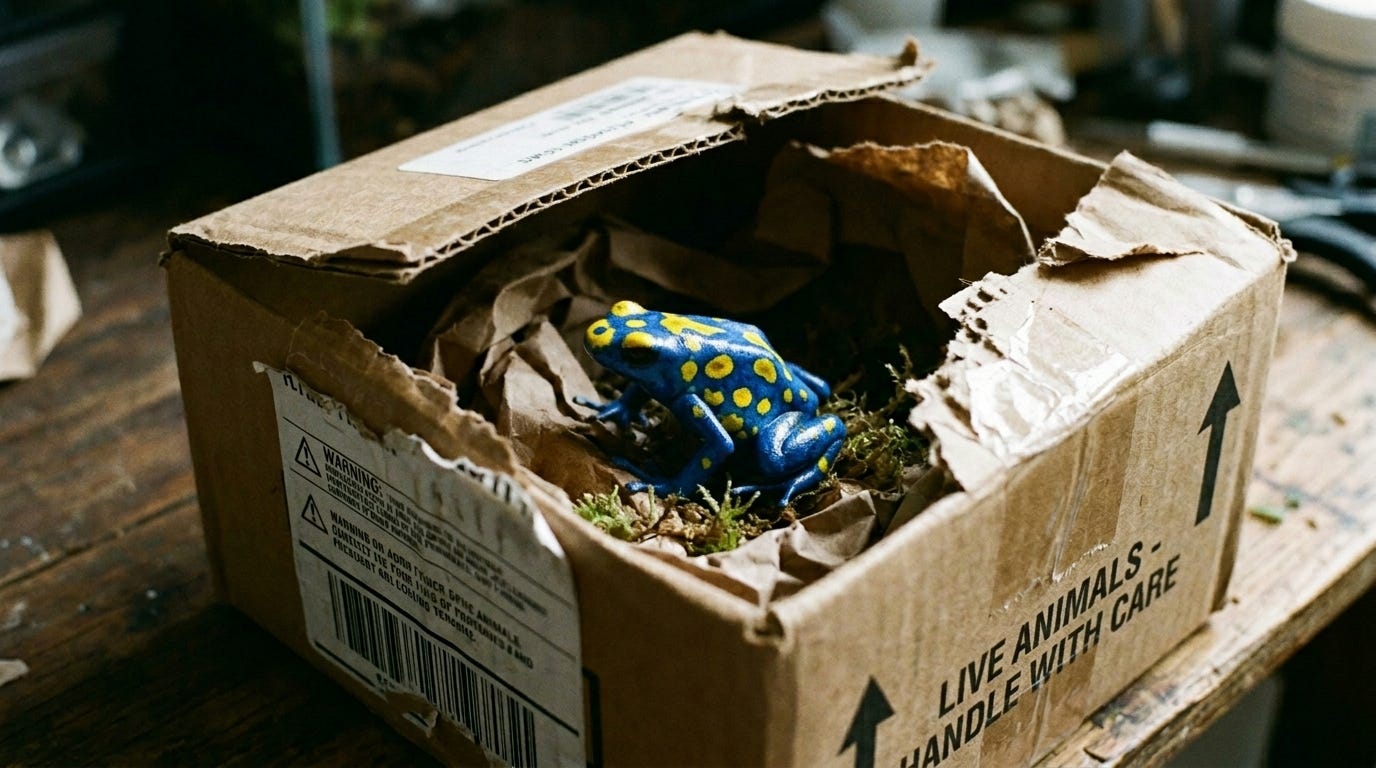
Helen ignored them both. She slipped the frog gently into a ventilated specimen box lined with damp moss. The creature didn’t resist. Its colours pulsed once, like a heartbeat.
She sealed the lid.
The rainforest did not resume its noise.
The Warnings
That evening, the Yaraí elders arrived at the camp. They refused to step inside the tent where the frog was kept. One elder, her face painted with ochre and charcoal, spoke softly but firmly.
“You must return it.”
Helen smiled politely. “We’re scientists. We only want to study it.”
The elder shook her head. “It studies you.”
Luis hesitated before translating that part.
Another elder added, “Its poison is not for killing. It is for remembering. The forest remembers through it.”
Tomás swallowed hard. “We should listen.”
Helen dismissed it as superstition. She had a grant to justify, a paper to publish, a species to name.
The elders left without another word.
The frog’s colours glowed faintly through the box.
The First Signs
By midnight, the camp felt wrong.
The air around the specimen box was warmer than the rest of the tent. Insects avoided it entirely. The frog’s colours pulsed in slow, deliberate waves, illuminating the cardboard like a lantern.
Helen heard faint clicking sounds from the trees — rhythmic, patterned, almost conversational.
Tomás woke screaming, a trail of tiny blue‑yellow footprints blooming across his forearm like a rash. He insisted he hadn’t touched the frog.
Luis found a symbol carved into a nearby tree: a frog with a single human eye.
He didn’t tell the others.
The Consequence
At dawn, the Yaraí returned — not with weapons, but with torches and ritual paint. They stood at the edge of camp, silent, waiting.
Helen stepped out of the tent holding the specimen box. “We’re not giving it back.”
The frog’s colours flared, bright enough to cast shadows.
The forest answered.
The trees leaned inward. The air thickened. The clicking sounds grew louder, echoing from every direction. The ground beneath their feet vibrated with a slow, steady rhythm.
Luis whispered, “It’s calling something.”
Tomás backed away, eyes wide. “No. It is something.”
Helen opened the box to prove a point.
The frog hopped onto her hand.
She collapsed instantly — not dead, but frozen, eyes wide, pupils dilated, as though listening to a voice only she could hear.
The frog sat calmly on her palm.
The Ending
Tomás fled into the rainforest and was never seen again.
Luis carried Helen’s unresponsive body to the Yaraí, who took her without question. They returned the frog to the base of an ancient ceiba tree. It hopped once, twice, then vanished into the roots as though the earth had been waiting for it.
The forest exhaled.
Weeks later, a shipping box was found washed up on a riverbank miles away — empty, but still warm to the touch.
The warning label remained intact.
DO NOT TOUCH SPECIMEN. SOME SPECIES MAY BE TOXIC.
RECOVERY TIME COULD BE LENGTHY.
The rainforest already knew.
As a child, I was always puzzled by the the number of brands labelled ‘ Frog’ , from toy aeroplane engines to heaters.